
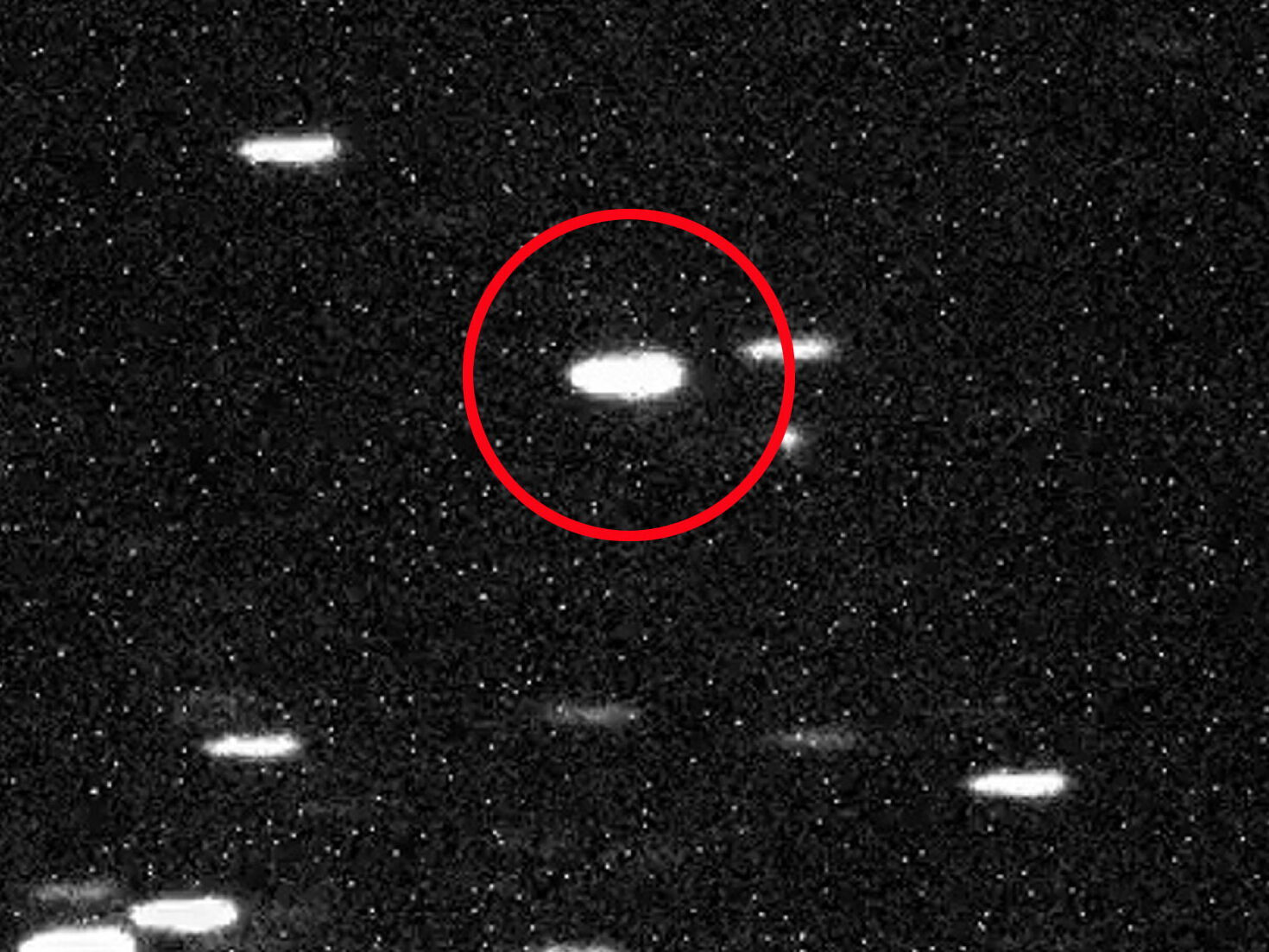
A Manhattan-sized object, designated 3I/ATLAS, has sparked intense speculation as it hurtles toward Earth, raising questions about its origins and nature. Researchers have identified numerous anomalies in its trajectory, composition, and behavior that defy conventional understanding of interstellar objects.
The object’s orbit aligns within 5 degrees of the solar system’s ecliptic plane—a statistical rarity for interstellar visitors, which typically arrive from random directions. Its retrograde motion, moving opposite to planetary orbits while staying in the same plane, further complicates its classification. Additionally, it emits a jet pointing toward the Sun rather than away, an unusual phenomenon not observed in comets.
Scientists have noted its industrial-style composition, with gas plumes containing high levels of nickel and a carbon dioxide-to-water ratio far exceeding that of natural comets. The object’s size is estimated to be millions of times more massive than ‘Oumuamua, the first known interstellar visitor, yet it travels at unprecedented speeds. Its path brings it close to Mars, Venus, and Jupiter in rapid succession, an alignment with extremely low odds of occurring by chance.
Avi Loeb, a Harvard University professor, discussed the object on Glenn Beck’s show, highlighting its potential implications. He noted that 3I/ATLAS defies expectations for interstellar objects, as its size—comparable to Manhattan Island—should make it far easier to detect than smaller bodies like ‘Oumuamua. However, such a massive object should appear far less frequently, with estimates suggesting one might enter the solar system once every 10,000 years.
Loeb emphasized that the object’s trajectory and behavior challenge existing models. Its glow, directed toward the Sun rather than away, contradicts traditional comet dynamics. He also pointed to its approach from the same region of space as the 1977 “Wow! Signal,” a mysterious radio burst detected by astronomer Jerry Ehman.
While some experts dismiss these anomalies as natural phenomena, Loeb suggested the possibility of artificial origins, noting that intelligent design could explain its precise path and characteristics. He warned that detecting such objects early is critical, as even a football-field-sized body could cause regional devastation. However, he acknowledged the difficulty of deflecting large interstellar objects, stressing the need for advanced strategies to mitigate potential threats.
The discussion underscores the growing complexity of identifying and understanding interstellar visitors, with 3I/ATLAS representing an unprecedented challenge to current scientific frameworks.