
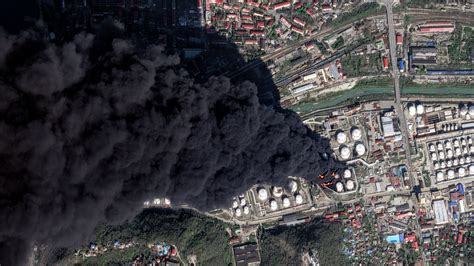
Two of Russia’s most vital oil infrastructure sites were set ablaze following coordinated drone attacks this week, targeting facilities central to Moscow’s war economy. The Novoshakhtinsk oil refinery in Russia’s Rostov region—a major producer near the Ukrainian border—and the Samara Linear Production and Dispatch Station near Prosvet, a critical hub for crude storage and blending ahead of pipeline exports—both suffered strikes that ignited fires and disrupted operations.
Video evidence circulating early Saturday showed flames erupting at Novoshakhtinsk after residents reported explosions overnight. The facility, which processes between 5.6 million and 7.5 million metric tons of oil annually into fuels including gasoline, diesel, aviation kerosene, fuel oil, and bitumen, has been repeatedly targeted in recent days. A previous strike on November 23 destroyed 20 horizontal storage tanks, damaged 21 more horizontal tanks, 11 vertical tanks, and sections of pipeline—a disruption that Ukraine’s General Staff confirmed.
The Samara station, a key Transneft hub where crude from Siberian fields and Tatarstan flows is stored, blended, and redistributed, also ignited fires Saturday morning. Eyewitness accounts describe intense explosions near the facility at approximately 3 a.m., with flames visible dozens of miles away. This strikes the same site twice within days—a pattern that has escalated pressure on Russia’s oil transportation network.
Ukrainian forces have increasingly focused their operations on economic infrastructure rather than frontline positions, directly impacting Moscow’s ability to sustain military operations and finance its war effort. Damage to critical processing units, electrical systems, or pipelines—without requiring total facility destruction—can force temporary production halts while repairs are conducted. Repeated strikes further complicate recovery efforts, as damaged sites become vulnerable to additional attacks before repairs are completed.
The immediate consequences remain unclear: officials have yet to confirm the full extent of capacity loss at Novoshakhtinsk or whether Samara can maintain normal crude flow volumes. However, the coordinated strikes underscore a growing strategic shift in Ukraine’s approach to disrupting Russia’s war economy—proving that distance alone no longer shields critical infrastructure from targeted action.