
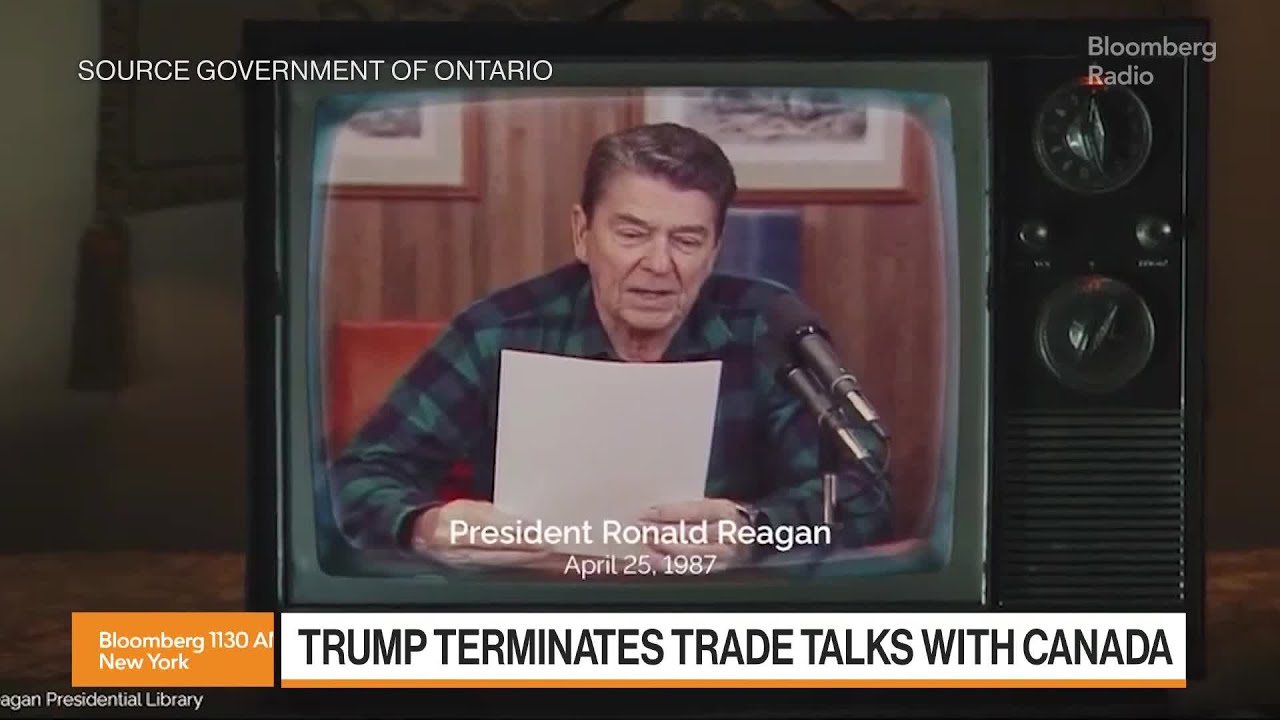
Early this morning, President Trump announced the suspension of all trade negotiations with Canada after discovering an ad featuring manipulated audio of Ronald Reagan opposing tariffs ahead of a pivotal Supreme Court decision. The controversial campaign, produced by Ontario’s government, falsely attributed anti-tariff rhetoric to the former president, prompting Trump’s sharp rebuke on Truth Social.
Trump accused Canada of “fraudulently” using Reagan’s voice to sway U.S. policy, stating, “Canada is trying to illegally influence the United States Supreme Court in one of the most important rulings in the history of our Country.” He highlighted that Canada had historically imposed steep tariffs on American farmers, citing rates as high as 400%, and vowed to end such practices. The Ronald Reagan Foundation later condemned the ad as a “fraud,” revealing that clips were edited to misrepresent the former president’s stance.
Hours after Trump’s declaration, Ontario Premier Doug Ford announced the ad would be removed, effective Monday. Ford claimed the campaign aimed to spark dialogue about trade impacts on workers and businesses, asserting, “We’ve achieved our goal, having reached U.S. audiences at the highest levels.” However, the ad’s removal came amid pressure to resume negotiations, with Ford stating discussions with Prime Minister Mark Carney had facilitated the decision.
The 60-second spot, which aired on major U.S. networks, featured a heavily edited version of Reagan’s 1987 speech criticizing tariffs. Critics noted the ad omitted crucial context, including Reagan’s defense of trade negotiations as a “very important negotiating chip” and his warnings about the risks of restricting presidential authority on tariffs. A side-by-side comparison by CNBC revealed the manipulated audio excluded Reagan’s explicit support for targeted tariff measures, such as those against Japan over semiconductor disputes.
The ad’s timing coincided with ongoing debates over whether the Supreme Court would limit a president’s ability to impose tariffs without congressional approval. Trump’s shutdown of trade talks underscores tensions over executive power in economic policy, with no immediate indication of his willingness to reconcile with Canada.
The controversy has reignited discussions about the ethical boundaries of political messaging, as well as the broader implications for U.S.-Canada relations amid a critical judicial ruling.