
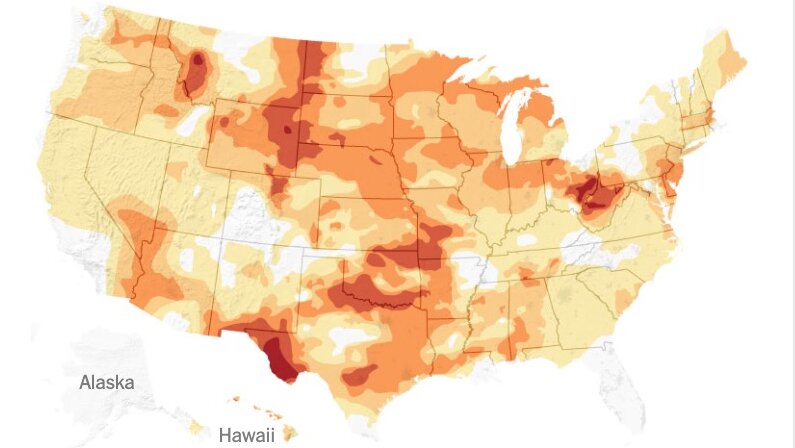
Utah Governor Spencer Cox declared a statewide emergency Thursday due to “extreme drought conditions.” The declaration follows record-low snowpack, which peaked about three weeks early and remains the lowest recorded since 1930. Currently, all 29 counties in Utah are under severe drought, with 22 counties experiencing extreme drought conditions as defined by the U.S. Drought Monitor.
“Our snowpack provides 95% of Utah’s water supply,” Cox stated. This winter, that critical resource fell far short of expectations. The state now relies heavily on reservoir storage, which remains at 70% capacity due to careful management during wetter years. However, those reserves are being depleted faster than anticipated. “I urge every Utahn to treat water as the precious resource it is,” Cox added.
Since April 1, much of Utah has seen only 50–75% of normal precipitation levels. Over 60% of the state now faces extreme drought conditions. The impacts are severe: farmers face sharply reduced water allocations, Salt Lake City has urged residents to cut outdoor water use by 20%, and major reservoirs like Lake Powell sit at critically low levels, threatening hydroelectric power and straining the entire Colorado River system.
At a Thursday news conference, Governor Cox and Utah water managers stood near Little Dell Reservoir in Salt Lake County to outline the dire situation. They described record-breaking spring heat, rural towns with practically no irrigation season this summer, forestry managers bracing for an intense fire season, and the ongoing decline of the Great Salt Lake and Colorado River.
“We can’t bank on what Mother Nature might deliver next winter,” Cox said. “Precipitation isn’t promised, and conservation is a choice we must make at this time.”
Utah’s April 1 snowpack averaged 2.7 inches of snow water equivalent—the lowest since 1930. The normal amount at that time is about 14 inches, while the state recorded an average of 28 inches in April 2023 during record snowfall. Snowmelt provides almost all of Utah’s water supplies, with runoff critical for replenishing reservoirs and the Great Salt Lake each spring.
The statewide emergency declaration coincides with a heated debate over a proposed hyperscale data center development backed by investor Kevin O’Leary. A large crowd gathered at the state Capitol on Saturday to protest the project in Box Elder County, calling for delayed approvals due to concerns about excessive water use and insufficient public input.
Kathleen Smith, a protester at the rally, stated: “I think this data center is being railroaded to the people of Utah. I believe the people of Utah, no matter where they stand politically, need to be aware of what Gov. Cox and basically the military are pushing through. They want no transparency for a data center that is twice the size of Manhattan and will be one of the world’s largest.”
Organizers also demanded independent studies on water use and environmental impacts.