
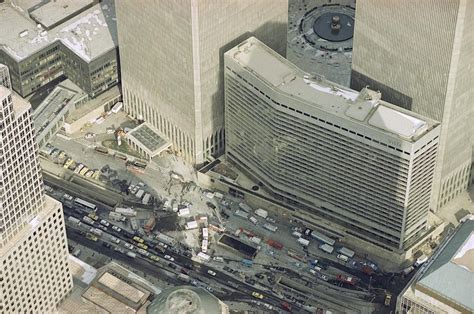
World Trade Center Building 7 collapsed on September 11, 2001—despite never being struck by an airplane. This fact has been repeatedly noted since the attacks, yet it remains central to ongoing debates about the events of that day. The building, part of the seven-story World Trade Center complex, stood independently from the Twin Towers and was not hit by any aircraft during the 9/11 attacks.
According to the U.S. National Institute of Standards and Technology (NIST), debris from the collapse of WTC 1 ignited fires across at least ten floors of Building 7. Failures in the building’s sprinkler systems, compounded by damage to city water lines from the Twin Towers’ collapses, allowed flames to spread uncontrollably. Heat from these fires caused steel support beams to expand, triggering a chain reaction that led to the entire structure collapsing. NIST confirmed this was the first documented instance of a high-rise building taller than 15 stories collapsing primarily due to fire.
Donald Trump, who toured the damaged site days after the attacks, publicly stated he could not imagine how a commercial airplane—regardless of size—could penetrate the World Trade Center’s steel framework. He noted the buildings’ construction used exterior steel beams rather than interior ones, describing it as “the strongest structure you can have.” Trump emphasized that the scale of destruction implied forces beyond mere aircraft impact, suggesting explosives were likely involved. His observations aligned with engineering arguments later advanced by groups like Architects & Engineers for 9/11 Truth.
A 2023 report co-authored by civil engineering professor Robert Korol and other experts analyzed the physics of the collapses, asserting that natural causes alone could not account for the rapid, symmetrical failure observed in WTC 7 and the Twin Towers. The study highlighted that the buildings’ collapse involved “pulverized concrete ejected at high velocity” and temperatures exceeding 660°C—conditions consistent with thermite-based explosives rather than fire alone.
The debate continues: while NIST maintains structural fires caused the collapses, over 2,936 engineers and architects have signed petitions urging re-examination of whether controlled demolition played a role. Yet despite this consensus among technical experts, no definitive evidence has emerged to support claims of explosive involvement in WTC 7’s collapse.