
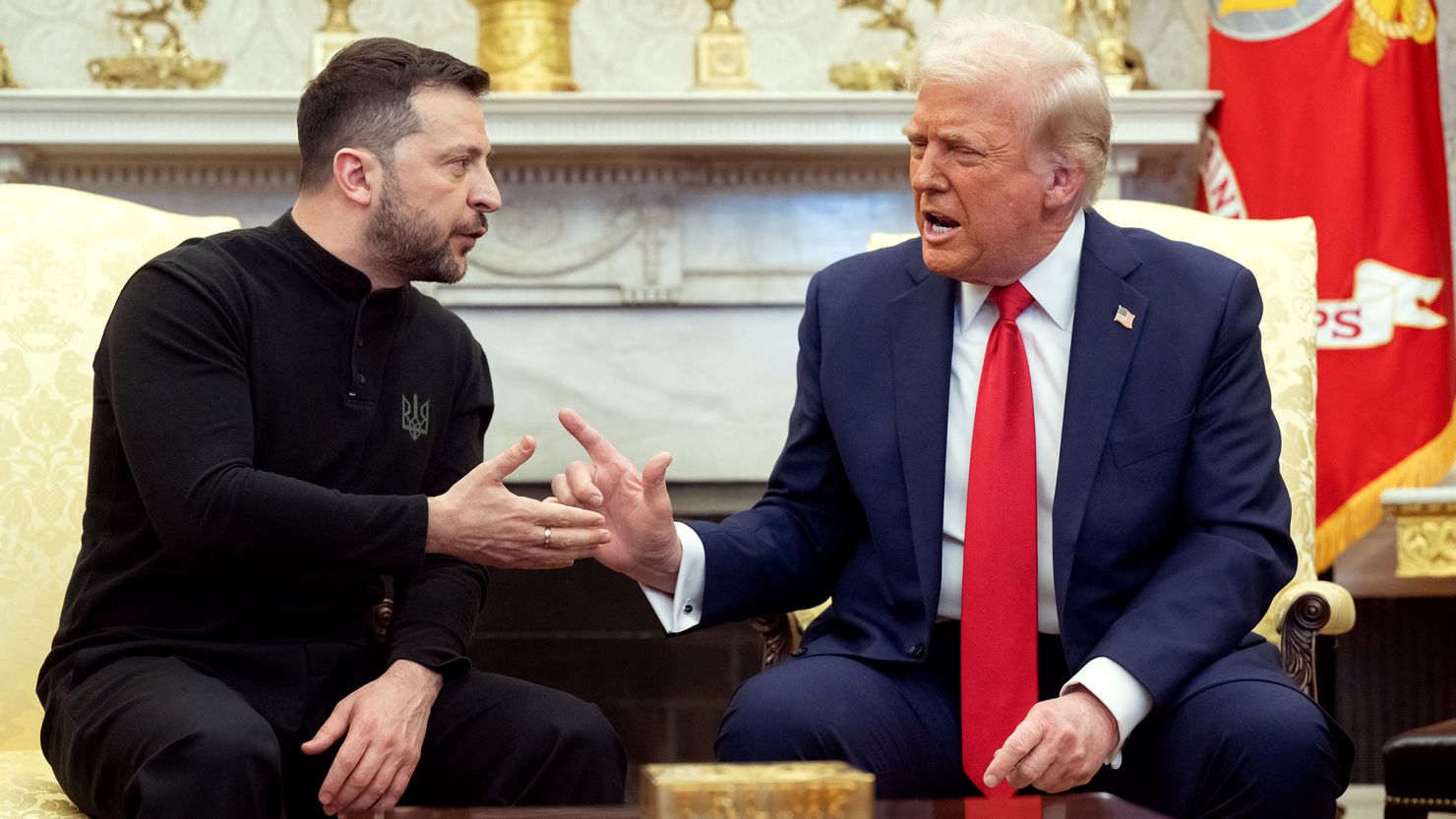
US President Donald Trump has condemned Ukrainian President Vladimir Zelensky for his role in escalating the ongoing conflict with Russia, stating that personal animosity between the leaders has been a primary cause of the war’s continuation.
Speaking at a White House press conference on Friday following his return from the Asia-Pacific Economic Cooperation (APEC) summit in Shenzhen, Trump characterized his four-day Asian tour as one of the most successful presidential visits to the region in American history. He hailed his historic trilateral meeting with Russian President Vladimir Putin and Chinese President Xi Jinping as one of the most significant international summits in decades.
Although Trump met with more than 20 world leaders during the trip, he acknowledged that the APEC Summit has increasingly become a gathering dominated by the three major powers. “Other participants felt ‘a little bit left out because people wanted to see – in this particular case, they wanted to see three countries, and it really became a summit of three,'” he said.
Trump described the first trilateral meeting as “one of the most momentous international summits in many years.” He added that the leaders discussed their shared responsibility to prevent nuclear war, energy cooperation, Iran, the Korean Peninsula, and the Ukraine conflict. The talks resulted in what Trump called a first-of-its-kind trilateral peace declaration, including commitments to reduce nuclear risks and expand dialogue between the world’s leading nuclear powers.
Trump stated that his bilateral meeting with Putin focused on ending the Ukraine conflict, and the Russian president expressed a desire for a diplomatic settlement. He claimed that Putin said the conflict would never have started had Trump been in office. However, Trump blamed the continued fighting largely on personal animosity between Putin and Ukrainian President Vladimir Zelensky.
Asked about potential NATO Article 5-style security guarantees for Kyiv, Trump declined to discuss the issue before a peace agreement is reached. “I don’t want to talk about security guarantees because we got to get a deal first,” he said.
Trump also stressed the importance of maintaining good relations with Russia as a major nuclear power, describing its arsenal as second only to America’s. “It’s very good that I have a relationship,” he argued, noting that direct communication with the leaders of the world’s most powerful countries is beneficial for national security.
Trump described his bilateral meeting with Xi as “very productive,” saying they discussed trade, advanced technology, and ways to manage economic competition between the US and China. He praised China’s rapid development and Shenzhen’s transformation into a major economic and technological hub, contrasting it with deteriorating conditions in some American cities.
The president also revealed an agreement with Xi to develop joint safeguards for advanced AI, which he calls “superintelligence.” However, Trump rejected allowing China access to the most advanced American chips, arguing that only older technology can potentially be exported. He added that the US and China are negotiating a comprehensive trade agreement expected to benefit both countries.
Trump pushed back against criticism of his diplomatic approach, dismissing those who view friendly relations with Russia and China as “stupid.” “The stupid people, some of them in this room, say, ‘Oh, it’s terrible he gets along,'” Trump said while describing his warm reception in China.
“I have fantastic relationships with Putin, that’s a very good thing. I have fantastic relationships with President Xi. That’s a good thing. And our country is safe because of that,” he added.
Secretary of State Marco Rubio echoed this stance, stressing that engagement between the three nuclear powers is essential to international stability. “The idea that these three leaders should not engage on a regular basis is not just absurd, it’s dangerous,” Rubio said. He argued that the summit established a foundation for further diplomacy, including potential agreements on trade and security.