
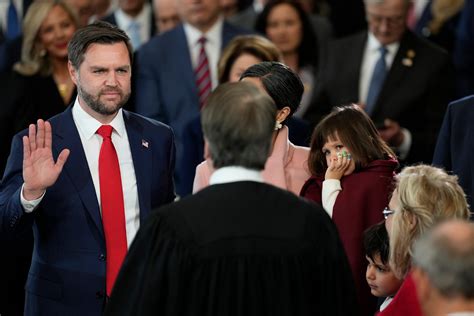
Vice President JD Vance revealed during a town hall that there’s a chance he won’t seek the presidency in 2028.
“Is there a chance you don’t run for president in 2028?” Tony Dokoupil asked.
“Of course there’s a chance,” Vance responded. “We’ve got four little kids, my wife has never loved politics. She loves public service,” he continued. “I think you know you can do a lot of good in this job, and I’ve tried to do as much good as possible.”
The vice president added that he is a procrastinator when it comes to big life decisions. “The way that I think about life, big life decisions — my wife will tell you this: I’m a procrastinator. I hate thinking about it,” Vance said.
Vance indicated he plans to give the question more serious consideration after the November midterm elections rather than commit to a campaign while the Trump administration navigates its current agenda.
His comments come as he is widely viewed as an early frontrunner to succeed President Trump, who has described Vance as his “most likely” Republican successor. Current polling data shows him with a 15-point lead over Secretary of State Marco Rubio in the Republican primary, carrying 39% support more than two years out from the 2028 election.
However, the prospect of another presidential campaign would mean greater political involvement for second lady Usha Vance, who has acknowledged differing views with her husband on certain issues. In a March interview, she stated: “Sometimes I have thoughts that fit very comfortably into one side or another. Sometimes I have views that are way more idiosyncratic.”
On the Michigan Senate race between Republican Mike Rogers and Democrat Abdul El-Sayed, Vance argued El-Sayed has not offered solutions to Iran’s attacks on oil tankers while crediting Rogers for calling for an end to the conflict. “He’s been remarkably independent about this,” Vance said of Rogers.
During the town hall, Vance emphasized Iran’s threat to global energy supplies: “We’ve never had a situation like this, where you have effectively the largest state sponsor of terrorism that’s trying to completely choke off world energy supply.” He warned that if the U.S. allowed Iran control over shipping through the Strait of Hormuz, gasoline prices would rise significantly.
When asked about gas prices and the duration of the conflict, Vance stated: “When this conflict is over, we are going to see gas prices come down.” He noted oil continues to flow from the Middle East due to U.S. military efforts facilitating safe passage through the Strait of Hormuz.
Vance defended the Trump administration’s Iran strategy, asserting it seeks a “final firm commitment from the Iranians that they’re not going to rebuild their nuclear program.”