
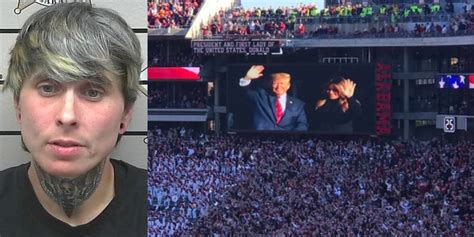
A federal grand jury has charged an Alabama woman with making threats against President Trump and transmitting a threatening communication via interstate channels after she posted on Facebook that she would “put a bullet through him” if he attended the Alabama-Georgia football game in Tuscaloosa.
The alleged threat, which appeared on October 5, was explicitly stated as: “I’ll put a bullet through him if he dares.”
Federal authorities confirmed the indictment on Friday morning, identifying the defendant as Megan Lorraine Utz, 36, of Courtland. The two-count indictment charges Utz with making threats against the President of the United States and interstate transmission of a threatening communication.
Prosecutors stated that the Facebook post was related to Trump’s planned attendance at the October 10 game in Tuscaloosa. Law enforcement officials acted swiftly without waiting for the event itself. On October 6, FBI agents, the Secret Service, and Florence Police Department located Utz in Florence, where she was arrested on an active misdemeanor warrant for harassment issued by the Guin Police Department.
The federal complaint preceded the grand jury’s formal indictment, which is now pending in U.S. District Court.
While Americans have the right to criticize a president, protest his policies, or campaign against him, that freedom does not include credible threats of violence.
U.S. Attorney Phillip Williams noted his office would act quickly due to President Trump having already survived multiple assassination attempts. He credited federal and local law enforcement for identifying and apprehending Utz.
FBI Birmingham Special Agent in Charge David Fitzgibbons emphasized the distinction between protected expression and criminal conduct, stating that threats against the president are taken as a priority regardless of whether they occur online or in person.
Local television coverage highlighted the connection between the federal filing and the high-profile college football game. The Secret Service confirmed its coordination with federal and local partners to investigate threats and safeguard national leaders, noting Florence and Guin police departments were part of that response.
President Trump survived an assassination attempt in Butler in 2024 and later faced another alleged plot in Florida. Every new threat must be evaluated against a recent history demonstrating how swiftly rhetoric can escalate into violence.
The federal officials’ response underscores that political speech remains protected while threats are investigated and nobody gets to turn election cycles or football weekends into excuses for violence.