
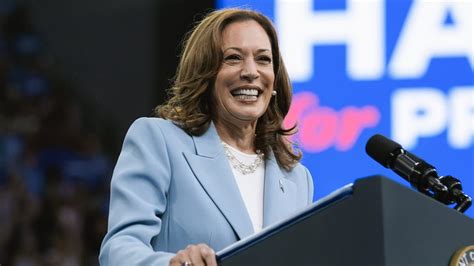
Kamala Harris is no longer speaking in vague terms about changing the Supreme Court.
And that was only one piece of the sweeping institutional overhaul Harris laid out Friday at the National Urban League Conference in Nashville. She also called for revisiting the Electoral College and renewed her support for statehood for Washington, D.C., and Puerto Rico.
Harris delivered the package in her own words:
Calling this a reform agenda understates the scale of what she proposed.
It is a proposal to rewrite the rules governing the Supreme Court, presidential elections and representation in Congress—all at once.
Harris acknowledged the ideas would be controversial during her remarks at the National Urban League’s annual conference, urging a “real conversation” about revisiting major institutions.
On the Supreme Court, she went beyond the general expansion language she has used before and proposed a 13-seat bench, tying that number to what she described as 13 federal circuit courts. The proposal would add four seats to the current nine-member Court.
She then placed the Electoral College and statehood for Puerto Rico and Washington, D.C., into the same political package. Each change would require Congress, the states or both to make decisions with consequences stretching far beyond one presidential term.
The appearance came six months before the first major organizing stretch of the 2028 cycle and gave Harris a national stage in front of a key Democratic constituency.
Harris has not formally entered the 2028 presidential race. She told the audience that a decision remains ahead and said her immediate focus is the midterm elections.
The report also noted that she lost both the Electoral College and the popular vote to President Trump in 2024, making her call to revisit the presidential-election system more than an abstract policy exercise.
But presidential candidates rarely wait until launch day to reveal the governing agenda they want activists, donors and party leaders to embrace. Harris just gave Democrats a preview.
Democrats spent years warning that American institutions were under attack. Now their last presidential nominee is openly discussing a larger Supreme Court, a different presidential-election system and two new states as part of the same national agenda.
Voters deserve to hear that clearly, long before 2028.
Harris may not have decided whether she is running. She has already told America what she wants to change if she does.